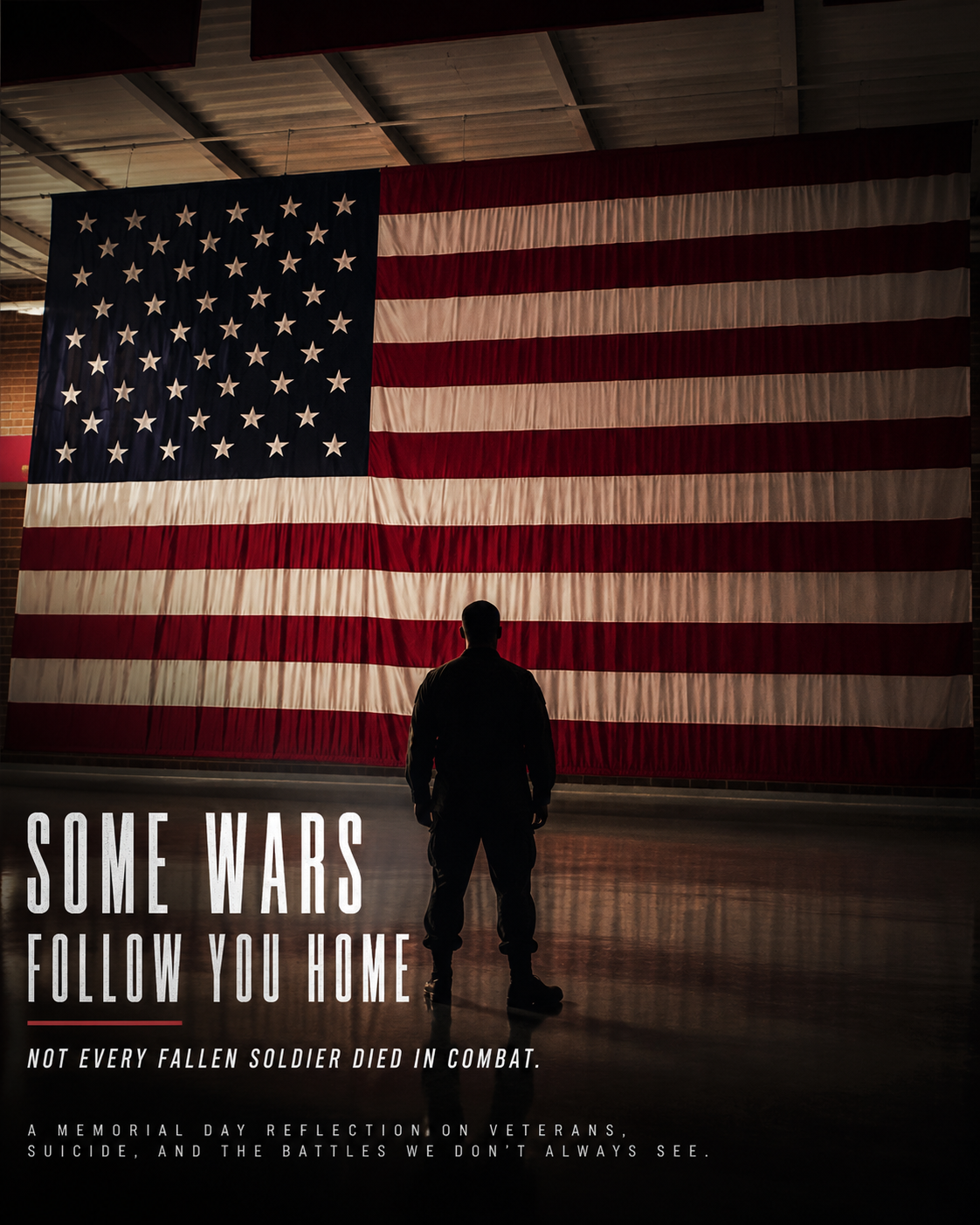
Some Wars Follow You Home
Not every fallen soldier died in combat.
Memorial Day has always carried a certain heaviness for me, but not always for the reasons people might expect. Like many Americans, I grew up understanding the holiday as a time to honor those who died in war. Flags wave across neighborhoods, families gather around grills, old photographs are reposted online, and somewhere beneath all the celebration sits remembrance. At its core, Memorial Day asks us not to forget sacrifice. But the older I get, and the more I reflect on my own experiences serving in the military and working in behavioral health, the more I realize there are some forms of sacrifice our country still struggles to fully acknowledge.
Some service members never stopped fighting after they came home. During my time in the United States Army as a Behavioral Health Technician, I had the opportunity to sit with soldiers during some of the most vulnerable moments of their lives. Many of the conversations I experienced were not dramatic in the way movies often portray military trauma. Most of the time, the pain sounded ordinary. It sounded like exhaustion. Like uncertainty. Like people trying to reconnect with their families after years of emotional distance. It sounded like service members struggling to rediscover purpose after the structure of military life began to fade. Sometimes it sounded like silence itself, because many people had become so accustomed to carrying weight privately that they no longer knew how to explain what they were feeling out loud.
That experience changed the way I view strength. Before serving, I think I understood strength the way many young men do. I associated it with endurance, discipline, toughness, and the ability to push through discomfort without complaint. The military reinforces many of those ideas because, in many ways, it has to. People are trained to function under pressure, to adapt quickly, and to complete the mission regardless of what they may be feeling internally. But what I slowly came to understand is that survival mode does not always disappear once a deployment ends or once someone separates from service. Many veterans return home physically while parts of them remain emotionally attached to the environments they had to survive in. The body may be sitting safely in a living room with family, but the mind is still scanning for danger, still carrying responsibility, still trying to process years of emotional suppression that never had space to breathe.
That reality becomes even more difficult because military culture often rewards composure. A soldier can smile, joke, show up to work, pass physical fitness tests, and still be quietly struggling in ways nobody around them fully sees. Pain does not always announce itself loudly. Sometimes it appears in isolation, in sleepless nights, in emotional distance, in drinking too much, or in the habit of telling everyone “I’m good” simply because it feels easier than explaining otherwise. Over time, many veterans become experts at functioning while hurting, and unfortunately that can make it difficult for others to recognize when someone is truly nearing their limit.
As I reflect on Memorial Day now, I find myself thinking not only about those who died in combat, but also about those who survived war only to later lose their lives to battles that continued internally long after the uniform came off. I think about veterans who spent years trying to reacclimate to civilian life while carrying experiences they never fully unpacked. I think about service members who struggled with the loss of identity that can happen after leaving the military, where purpose, structure, and belonging once shaped daily life. I think about the emotional weight of feeling disconnected from people who may appreciate military service symbolically but cannot truly understand what that transition feels like psychologically.
Most of all, I think about the families and friends left behind.
There is a unique kind of grief that exists within the military and veteran community because the relationships formed through service often carry a depth that is difficult to explain to civilians. People see each other under stress, exhaustion, fear, homesickness, and pressure. They become witnesses to versions of one another that few outsiders ever encounter. Because of that, losing a fellow veteran or service member can create questions that linger for years. People replay conversations in their minds. They wonder whether they missed signs. They question whether one more phone call, one more conversation, or one more moment of honesty could have changed the outcome. That kind of grief can become especially heavy during holidays like Memorial Day because remembrance and loss begin occupying the same emotional space at once.
For veterans mourning another veteran this Memorial Day, I hope there is room to understand that grief does not always follow a clean or understandable path. Sometimes grief shows up as sadness, but other times it appears as guilt, numbness, frustration, emotional distance, or even exhaustion. Sometimes people spend years trying to make sense of losses that never fully make sense. The truth is that many individuals become so skilled at surviving quietly that even those closest to them cannot always see the full depth of what they are carrying internally. That does not mean their lives mattered less, nor does it mean those left behind failed them. It simply means that mental and emotional suffering can become incredibly difficult to recognize when people have spent years learning how to hide it.
That is why I believe conversations surrounding veteran mental health must become more compassionate, more honest, and more human. Mental health awareness cannot simply exist as a slogan repeated during difficult months of the year. It has to become part of how we treat one another consistently. It has to become part of how veterans speak to each other, how families support returning service members, and how communities create spaces where people feel safe enough to be truthful about what they are experiencing internally. Many veterans do not need pity. What they often need is connection, patience, understanding, and reassurance that their value did not end when their military service did.
What makes this conversation even heavier is knowing how widespread this struggle still is. According to the Department of Veterans Affairs’ most recent suicide prevention report, 6,398 veterans died by suicide in 2023, which averages to roughly 17.5 veterans per day. The report also noted that many of the veterans lost were not actively connected to VA healthcare or support systems during the final year of their lives.
The Department of Defense also reported that 471 service members across the Total Force died by suicide in 2024. While that number represented a decrease from the previous year, the long-term reality remains difficult to ignore: military and veteran suicide continues to affect thousands of individuals, families, and communities across this country every single year.
And behind every number is a human being.
A laugh somebody misses.
A voice that no longer answers the phone.
A family trying to understand what happened.
A friend replaying old conversations in their head wondering if there was a moment they should have noticed something differently.
That is why this conversation cannot only exist during awareness months or after tragedy strikes. Veterans do not simply need recognition for their service; many of them need genuine connection, emotional safety, community, and the ability to speak honestly without feeling like they are becoming a burden to the people around them.
Memorial Day should always remain a time to honor sacrifice, but perhaps part of honoring sacrifice also means acknowledging the invisible wounds that many service members continue carrying long after war ends. Not every casualty happened overseas. Some losses occurred quietly years later, inside homes, apartments, parked cars, and moments of silence where people felt unable to carry their pain any further. Those lives deserve remembrance too.
And for any veteran reading this who may be grieving someone they lost, struggling privately themselves, or simply feeling emotionally heavy this Memorial Day, I hope you understand that your life still matters beyond your service. Your worth is not limited to your rank, your deployment history, or the image of strength you feel pressured to maintain. You deserve support while you are still here. You deserve community while you are still here. And you deserve to be seen as a human being before you ever become another name people remember after it is too late.
If you or someone you know is struggling, the Veterans Crisis Line is available 24 hours a day, 7 days a week. Veterans, service members, and their loved ones can call or text 988 and press 1, or chat online through the Veterans Crisis Line. You do not need to be enrolled in VA benefits or healthcare to reach out for help. veteranscrisisline.net